Craft
Reading the motifs of temple jewellery
Lakshmi, the peacock, the mango and the lotus: what the figures on a temple piece mean, and how to tell a sharp casting from a soft one.
12 October 2026 · 6 minute read
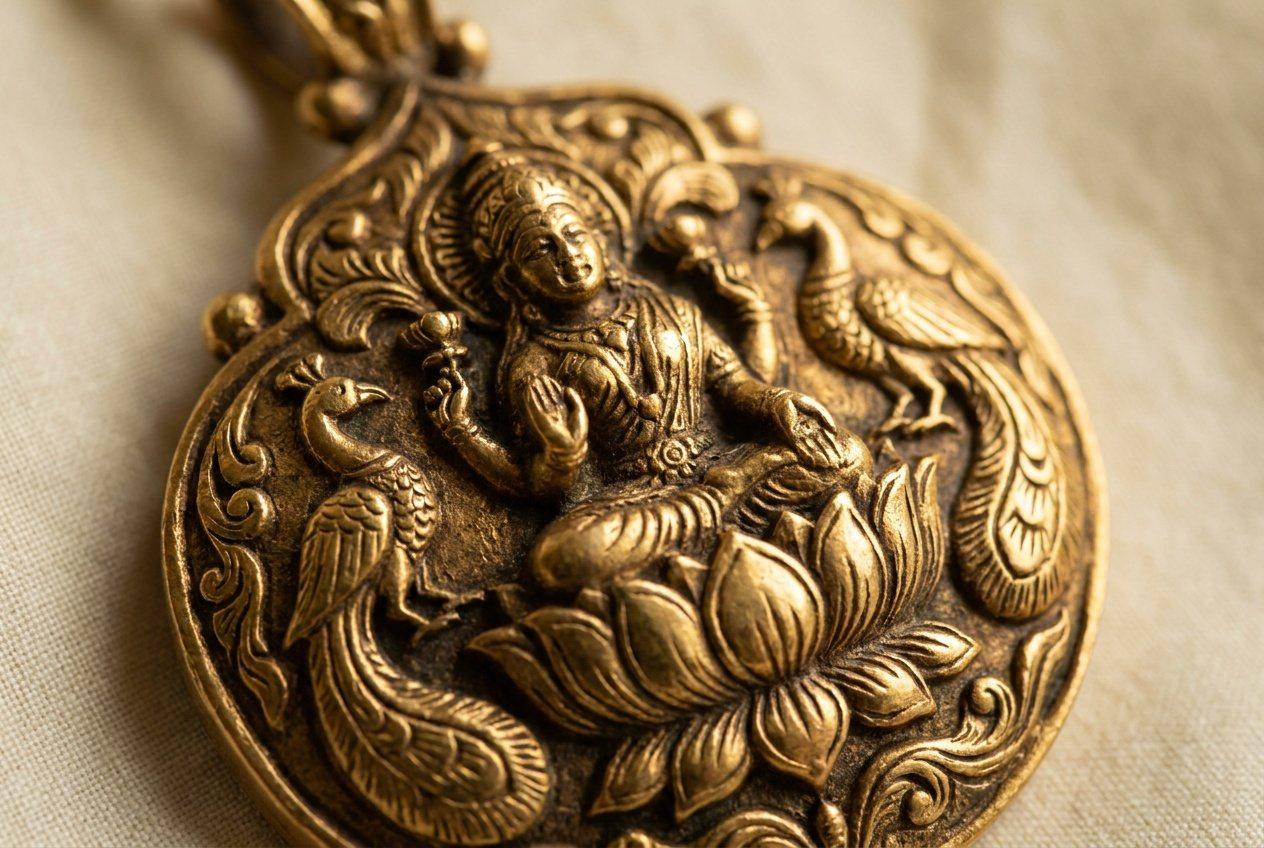
Temple jewellery began as what its name says: ornaments made for the deities of South Indian temples and for the dancers who performed before them. The forms that came out of that tradition, in Nagercoil and Kumbakonam and the goldsmiths' streets of Chennai, are the ones you see on a kasu mala or a vanki today, in gold and, far more often now, in gold plate. Each figure carries a meaning, and once you can read them a piece stops being decoration and becomes a sentence.
Lakshmi, seated and standing
The most common figure is Lakshmi, goddess of prosperity, seated on a lotus with elephants on either side (Gaja Lakshmi) or standing with a lotus in each hand. On a coin necklace every kasu carries her; on a pendant she sits at the centre under an arch. Look at her face: in a good casting the features are raised and distinct and the crown has depth. In a poor one, cast from a copy of a copy, the face is a smooth bump.
Peacocks, parrots and the hamsa
The peacock is Murugan's bird and stands for grace; a pair facing each other, tails raised, frames many a pendant. Parrots, Kamadeva's companions, mean love and are the bird of bridal pieces. The hamsa, the swan that can separate milk from water, means discernment and appears on the clasp and the side pieces, where only the wearer will see it.
Mango, lotus, rudraksha
The manga, or mango, is fertility and is the unit of the manga malai, strung in kemp. The lotus is purity and the seat of every deity. Rudraksha beads, rendered in metal, bring the austerity of Shiva into an otherwise abundant vocabulary, which is why a rudraksha mala suits men.
“In a poor casting the peacocks are identical blobs. In a good one they are twins.”
The counter
Telling a good piece from a poor one
- Turn the piece over. A well-finished piece is clean at the back; a careless one shows a grainy, pitted reverse and glue around the stones.
- Look at the recesses of the antique finish. Good antiquing is darker in the hollows and bright on the figures; a sprayed finish is flat and the same everywhere.
- Press each stone lightly with a fingernail. Nothing should move, and no glue should show at the edge of the collet.
- Weigh it in the hand. A good brass casting has heft; a hollow or thin one feels like a toy and bends.
None of this makes a piece more or less beautiful on the neck. It does tell you whether it will still be whole after the third wedding season.
Still have a question?
Write to us, call the store, or ask on WhatsApp. A person answers, during store hours, and often outside them.