The making
Four stages, many hands.
We do not make the pieces ourselves, but we know who does and how, and we check every one before it is sold. This is what happens between the mould and your box.
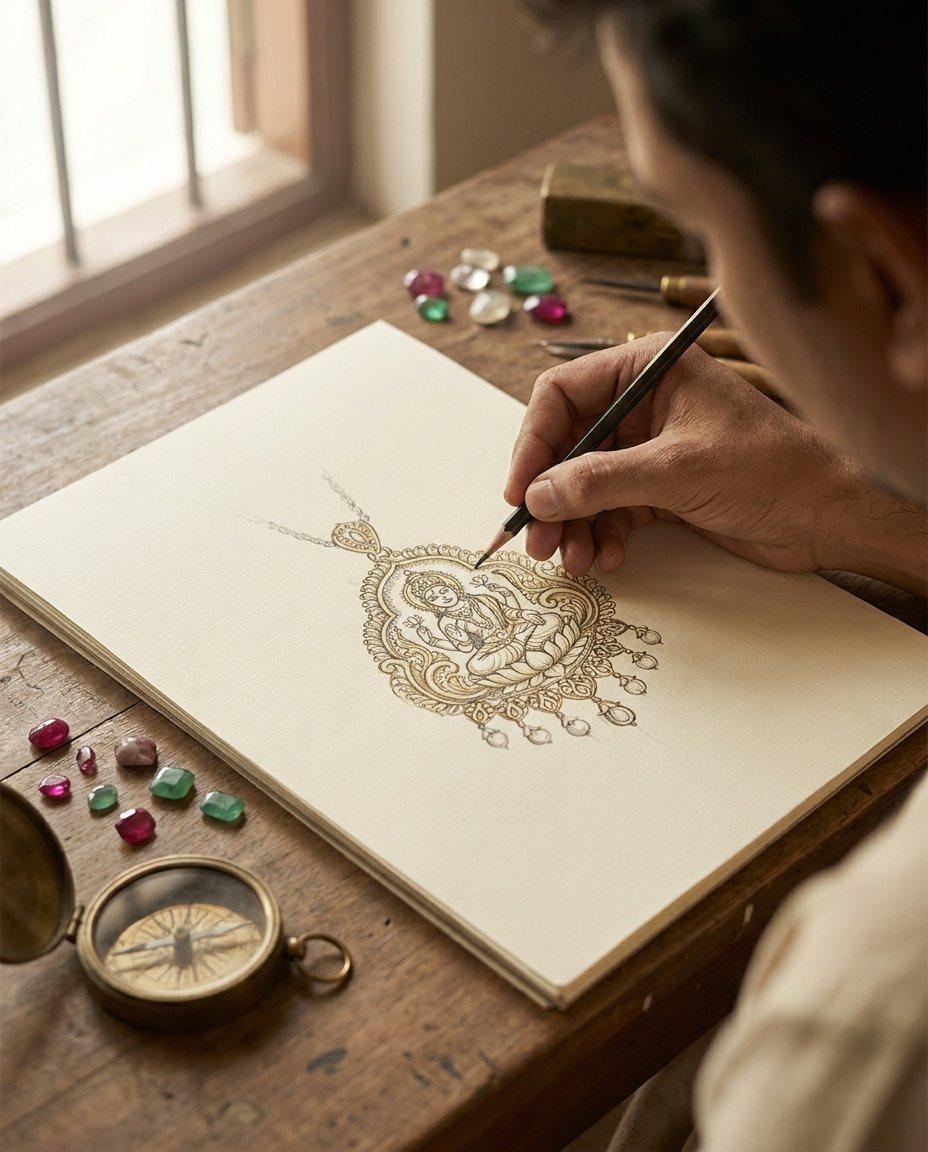
01 · Hundreds seen, dozens kept
Drawn and chosen
The pieces in this store are chosen, not simply stocked. Twice a season we sit with the karigars and small workshops we buy from, in Chennai and further afield, and go through their drawings and samples: a Lakshmi coin whose face is sharp enough to read, a peacock whose tail does not blur into a blob, a jhumka that hangs straight. Perhaps one design in ten makes it to the counter.
Many designs begin with a customer. Someone brings in a grandmother's haram and asks for the same look at a price that can be worn to every function rather than kept in a locker; the drawing of that piece, redone in brass, is how half our temple range began.
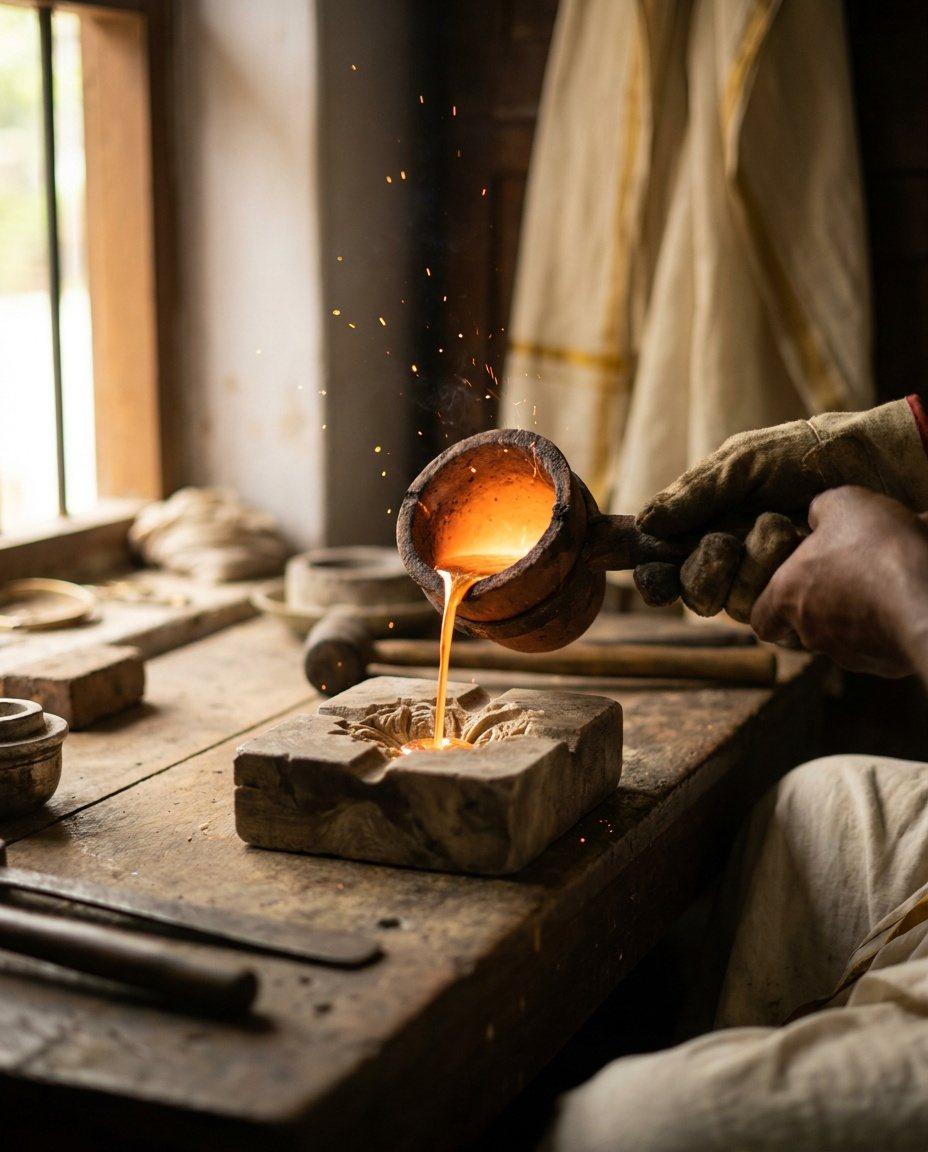
02 · Brass and copper alloy
Cast in brass
Imitation jewellery is honest about what it is: a base metal, usually brass or a copper alloy, cast in a mould taken from a master piece. What separates good from bad is the mould. A master cut by a skilled karigar gives castings whose figures are deep and distinct; a copy of a copy gives soft faces and smeared borders that no plating can rescue.
After casting, each piece is cleaned of its sprues, filed and polished before plating. This is where weight comes from: a well-cast haram has heft without being tiring, and a bangle rings when tapped.
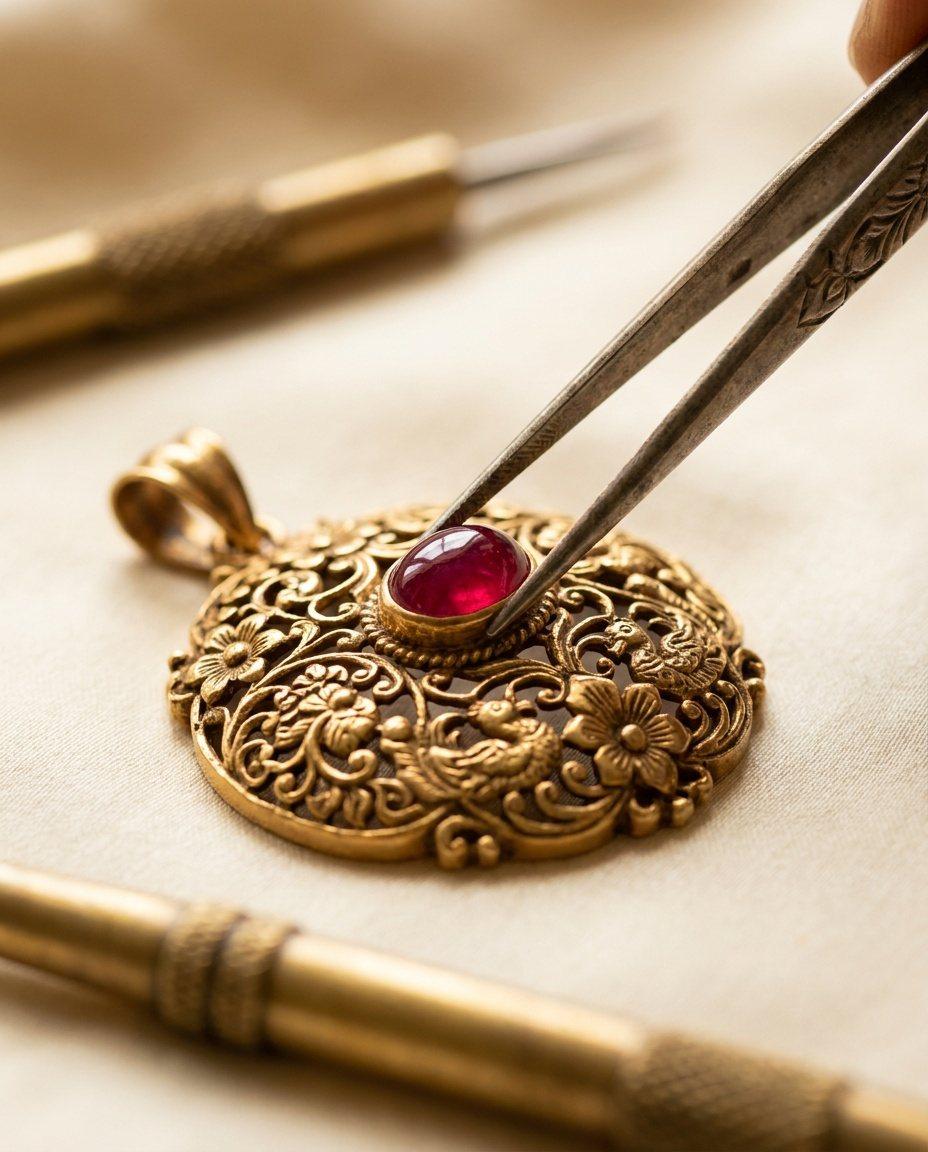
03 · Gold plated, hand set
Plated and set
Plating is a thin layer of gold-coloured metal deposited on the brass in an electroplating bath, then sealed with a lacquer that slows tarnish. The antique finish is a darker plating rubbed back on the raised work so the figures glow against a matted ground; the matte finish is the same plating left soft and even. How long any of it lasts depends far more on sweat, perfume and water than on the piece, which is why our care notes matter.
Stones are set afterwards: kemp (coloured glass cut in the old temple shapes), American diamonds, pearls and coral beads, each glued or closed-set by hand into its collet. A good setter leaves no gaps and no glue on show, and a stone that moves under a fingernail goes back to the bench.
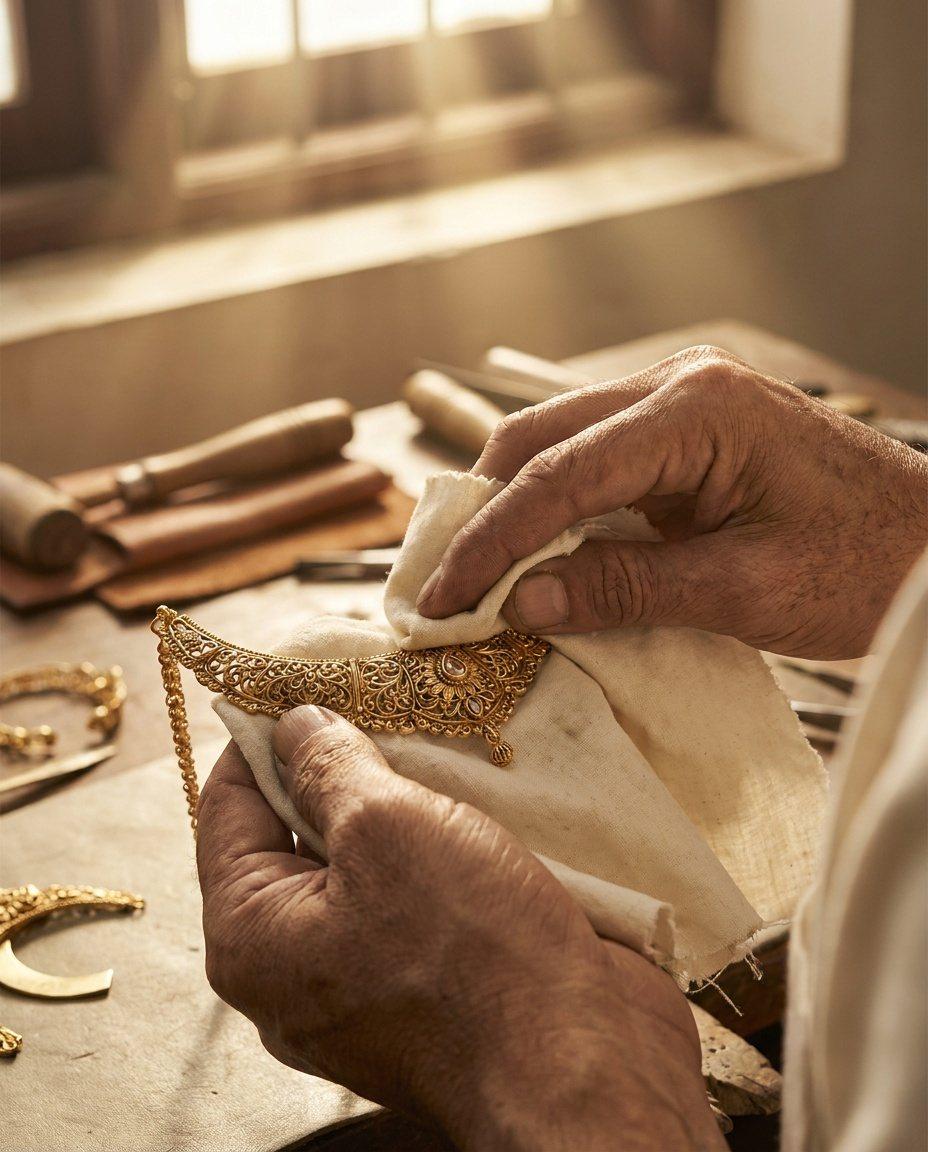
04 · Checked piece by piece
Checked and packed
Nothing leaves the store unchecked. Each piece is wiped, held to the light for bald patches in the plating, every stone pressed, every clasp opened and closed, every hook tried. A piece that fails goes back to the karigar, not into a parcel.
The piece is then sealed in its own pouch with a silica sachet against the monsoon, boxed, photographed for the order and handed to the courier with a GST invoice already in your inbox. If anything is still wrong when it reaches you, the seven-day replacement is there to put it right.
See it in the hand
Every piece on this site is on a counter in Iyyapanthangal.
Visit on a weekday and you can hold the pieces, compare finishes side by side and ask the people who chose them. Looking for a design you have seen elsewhere? Bring a photograph; we probably know who makes it.